


NANO Health Products
NANO CDSS
Clinical Decision Support System.
Most revenue is lost long before a rejection letter arrives — in how a case was priced, coded and documented. NANO CDSS reads that pattern against what payers actually approve, and tells you where your billing sits: above, below or on the average.
At a glance
A CDSS — clinical decision support system — gives clinicians and coders information at the point of decision. NANO CDSS applies that to the money: it compares your pricing and quotation against what payers expect, and shows where rejections and approvals concentrate by doctor, specialty and department.
- What it is
- A clinical decision support system focused on billing and pricing decisions
- What it compares
- Your pricing and quotation against the average of what payers expect
- What it surfaces
- Where rejections and approvals concentrate, by doctor, specialty and department
- Silent Mode System
- Runs without intervening, so you see the pattern before you change anything
- Integration effort
- None on the provider side — it works in the background, with no change to existing systems
- Coding standards
- CPT, and the AMA and AHIMA standards
What makes it different
Pricing analysis against payer expectations
Shows whether provider pricing and quotation is above, under, or on average compared to payers' expectations.
No integration headache
It does not require integration work from the provider side, and it follows the international coding systems.
Revenue grounded in real cases
Helps providers toward higher revenue based on actual experiences and examples, leading to increased billing where that is justified.
Runs in the background
Works in the background with no alteration to your systems and no complicated integrations.
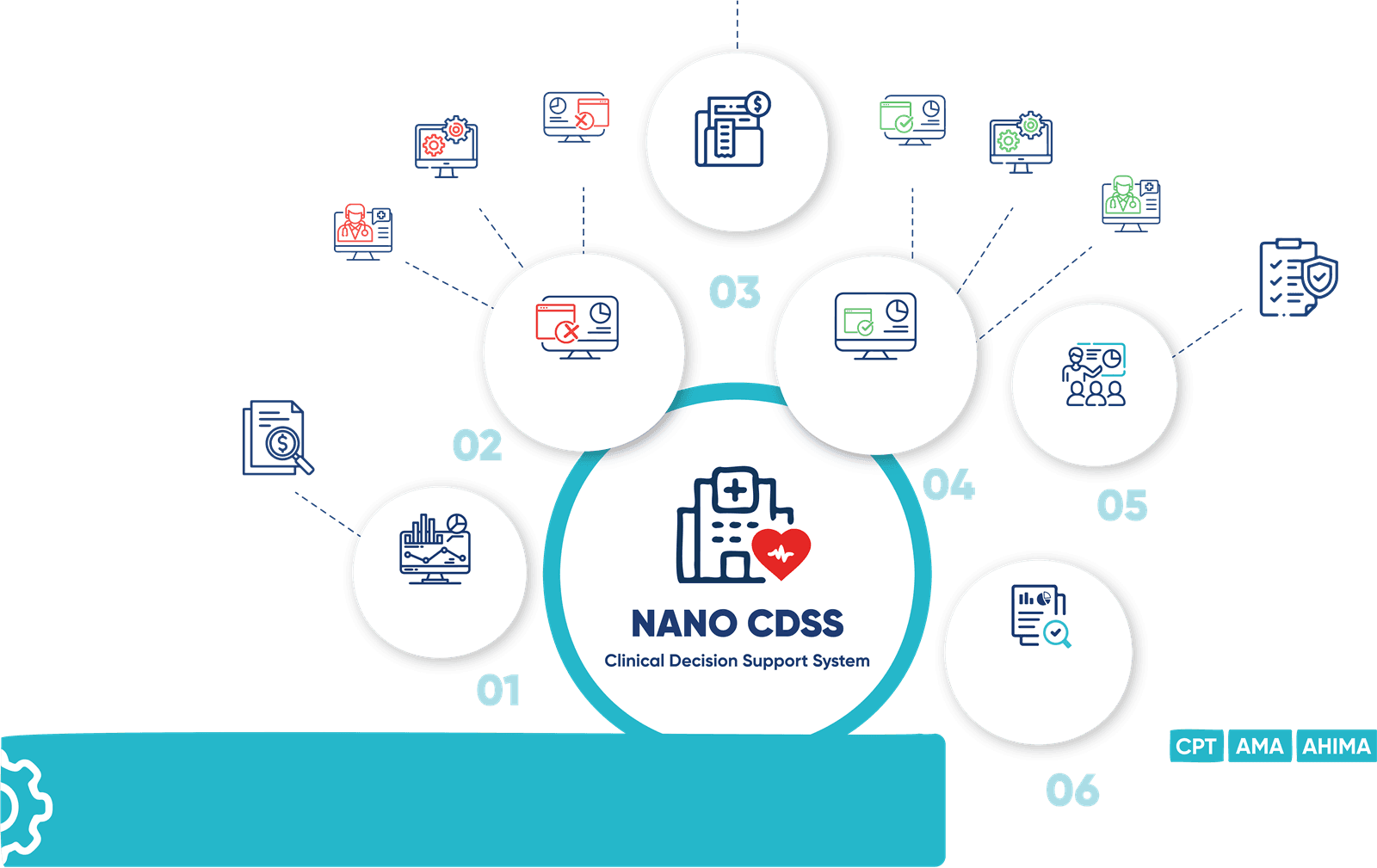
Six capabilities
Each one reports doctor-wise, specialty-wise and department-wise.
01
The Analysis Dashboard
02
Rejection Rate Analysis Dashboard
03
Silent Mode System
04
Approval Rate Analysis Dashboard
05
Billing Guide & Training
06
Historic Billing Audit
Every view, three ways
Doctor wiseSpecialty wiseDepartment wise
Standards it follows
CPTAMAAHIMA
Frequently asked questions
What does CDSS actually analyse?
- Whether your pricing and quotation sits above, below or on the average of what payers expect — and then where your rejections and approvals concentrate, by doctor, specialty and department.
How much integration work does it need from us?
- None on the provider side. It follows the international coding systems and works in the background, with no alteration to your existing systems and no complicated integrations.
What is the Silent Mode System?
- It is CDSS running without intervening — observing and analysing your billing in the background so you can see the pattern before you change anything.
What outcome should we expect?
- The deck's stated aim is reducing the rate of billing rejection, and supporting higher revenue where actual cases justify increased billing. We do not publish a headline percentage, because the honest answer depends on your current baseline.
Which coding standards does it work with?
- CPT, and the AMA and AHIMA standards.
What is a clinical decision support system?
- A clinical decision support system (CDSS) puts relevant information in front of a clinician, coder or administrator at the moment a decision is made, rather than leaving it to be found afterwards. In general the category covers alerts and reminders, order sets, diagnostic support and reference at the point of care. NANO CDSS applies the same idea to the financial side of the encounter: what you are charging, against what payers actually approve.
What kinds of clinical decision support exist?
- Broadly four: alerts and reminders that fire when something needs attention; order sets and pathways that make the recommended course the default; diagnostic support that suggests what to consider; and reference material surfaced in context. They differ in how much they interrupt. NANO CDSS is deliberately at the quiet end — it observes and analyses first, which is what the Silent Mode System is.
How does this relate to DRG grouping?
- They answer adjacent questions. Grouping decides which payment class an episode falls into, given the coded record. Decision support asks whether what you are charging for that episode sits above, below or on the average of what payers expect, and where your rejections concentrate. A hospital can be grouping correctly and still be pricing in a way that generates avoidable rejections.
Who actually uses it day to day?
- Three groups. Revenue-cycle and billing teams use the rejection and approval analysis to see where denials cluster. Clinical leads use the by-doctor and by-specialty view to understand where a pattern is departmental rather than individual. Finance uses the pricing comparison when quoting and when negotiating with payers.
What is the Historic Billing Audit for?
- It is the retrospective half. Rather than waiting to accumulate new data, the audit runs over billing you have already submitted and shows where the rejections concentrated and where pricing sat against payer expectations. It means the first useful answer comes out of history you already have, rather than out of a pilot period you have to sit through first.
What does Billing Guide & Training add?
- Analysis only pays off if behaviour changes, and most rejection patterns trace back to how a small number of people bill a small number of case types. The billing guide turns what the dashboards find into specific guidance, and the training puts it in front of the doctors and coders whose cases are actually driving the pattern.
How is this different from a claim scrubber?
- Timing, and what each one is allowed to change. A scrubber reads a finished claim and checks it against the rules a payer will apply, so it can reject or correct but it cannot alter the clinical and pricing decisions already made. Decision support arrives earlier, while the decision is still open, and is concerned with what you are about to charge against what the payer is likely to approve. The two are complementary rather than alternatives: the earlier intervention prevents the rejection, and the later one catches what still slipped through.
See it against your own billing
Bring a period of historic billing and we will show you where the rejections concentrate and what the pricing analysis says.
Related products
Products in the suite that work alongside this one.
More about this product
Standards and code sets
- CPT
- AMA
- AHIMA
How this works with the rest of the suite
- NANO DRG
Grouping decides the class an episode lands in; CDSS shows whether what you charge for it matches what payers actually approve.
- NANO PBM
The two halves of payer expectation: CDSS covers the clinical and procedural side, pharmacy benefit management the medicines side.
- NANO AI CDI 360
CDSS tells you where the rejections are; documentation integrity is usually where the fix is.
- NANO MAS
Analysis finds the pattern in historic billing; auditing is the formal review that follows it.
- NANO MCRW
Once you know which rules your rejections cluster around, the rules wizard is where your own team encodes them.
Related questions
- What does the wider health-IT platform cover?
- Can the record be captured by voice, in Arabic?
- How do we scrub claims before they are sent?
- Where do fraud, waste and abuse get detected?
- What is a clinical decision support system?
- What is a DRG system?
- What is clinical documentation integrity?
- What is pharmacy benefit management?
- See every product in the suite